
Everyone attacks bad MRO data. Most do it from behind a desk.
There are five common ways companies try to fix parts data. Each one solves part of the problem and stops. Here is where each stops, and the question to ask before you buy any of them.
The job has four stages. Ask any vendor which ones they own.
Fixing MRO data takes four steps: capture the truth at the shelf, enrich it with AI, verify it with people who know parts, and remember it in a knowledge graph so the next count starts smarter than the last. Most vendors own one stage. A few own two. The value is not in any single stage. It’s in the loop.
Data cleansing and cataloging firms.
What they do well: taxonomy, description formatting, algorithmic deduplication, at a good price per record. If your records were accurate and just messy, this works.
Where it stops: they work entirely from your export, and the export is the problem. The true manufacturer isn’t in your ERP. It’s on the label, the packaging, or the stamping of the part sitting in bin 14. A desktop cleanse polishes records that were wrong when they were typed, and the data starts decaying again the day the project ends. That’s why companies end up paying for cleansing twice and being unhappy with the results every time.
This is why companies end up paying for cleansing twice.
The question to ask: how many of your people will be standing in my storeroom?
Physical inventory counting firms.
What they do well: scale and speed. Crews show up, count everything, and hand your auditors a number. If a number is all you need, this is fine.
Where it stops: a count produces a quantity and nothing else. The crews producing it are trained to count, not to know parts. They know 6 comes after 5. They don’t know a motor operated valve from a solenoid, so nothing on the label, the packaging, or the stamping gets captured or questioned. The one time all year someone touches every part in the building; all you get back is a tally. Next year: same money, same binder, same decayed data.
The question to ask: what does my item file look like the day after you leave?
ERP, EAM, and CMMS data governance modules and catalog add ons.
What they do well: workflows, approvals, and one home for the record. Governance matters, and the system of record should stay the system of record.
Where it stops: a system of record can’t verify itself. It stores whatever it’s given with perfect reliability, which means bad data survives every migration and every module. Text-matching can’t tell that two differently named records are the same physical part, or that two identical-looking records are different parts. That knowledge lives on the shelf, not in the database.
The question to ask: where does the module get the truth it enforces?
General purpose AI enrichment run against your item master export.
What they do well: fast, cheap attribute extraction and readable descriptions at volume. Genuinely impressive on clean consumer style catalogs.
Where it stops: it reads the same bad export the desktop cleanse reads, trained on the same public data that OEM part numbers were built to obscure in the first place. No photos, no labels, no stampings, no evidence. It produces confident guesses, and a confidently wrong attribute in an item master is worse than a blank one. Someone will order against it.
The question to ask: what evidence sits behind each attribute, and who signed off before it touched my ERP?
Parts database platforms that match your records against a pre built manufacturer catalog.
What they do well: instant matches and spec fill when your records already carry a complete manufacturer name and an exact part number. On a clean item master, this is fast and satisfying.
Where it stops, twice. First: matching needs the very data you’re missing. If the manufacturer field says the OEM’s name and the number is the OEM’s number, which in MRO it usually does, the match either fails or just confirms the record as it stands.
Second, and this is the part nobody says out loud: those databases are largely built from OEM catalogs. So even a clean match validates the OEM’s part number at the OEM’s price. It standardizes your dependence instead of breaking it. If you’re fixing parts data to stop paying 3x to 10x markups for relabeled parts, a database match is a faster road to the same invoice.
The question to ask: after you match my records, whose part number and whose price am I buying against?
A note on inventory optimization platforms: they are not on this list because they are not trying to solve this problem. Optimization platforms decide how much to stock and where; they perform exactly as well as the data they are handed. ARIVA is how the data they are handed becomes true. The same goes for your ERP and EAM: they stay the system of record. ARIVA makes all of them perform better.
ARIVA owns the whole loop.
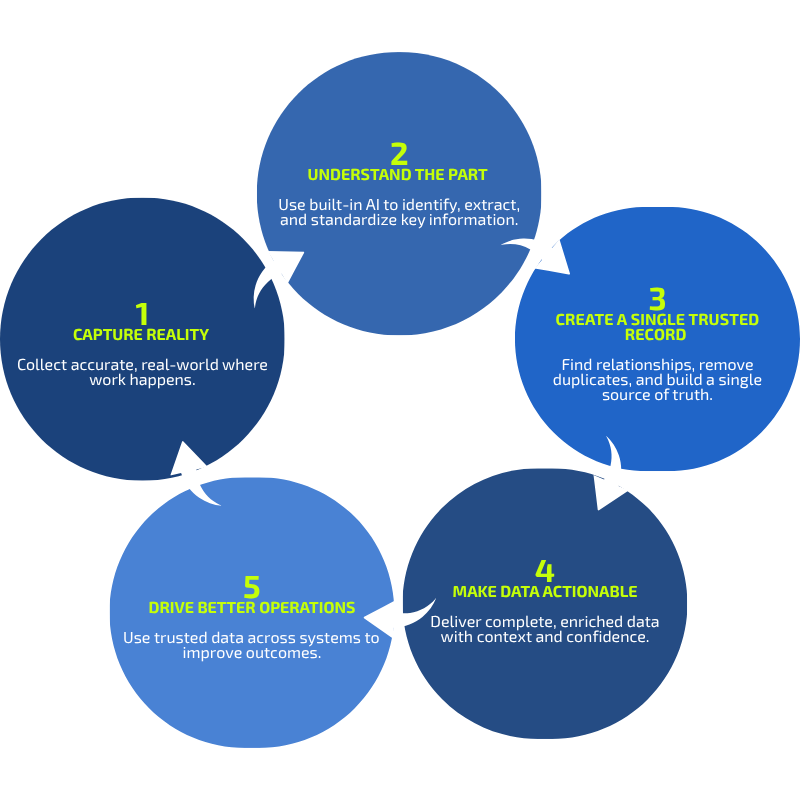
Because the loop rides on required inventory activity, the data does not decay after a project. It improves every time you count. The count you already have to do pays for the platform.
| Capability | Desktop cleanse | Count Service | System Module | Generic AI | Database Match | ARIVA |
|---|---|---|---|---|---|---|
|
Evidence captured at the shelf (labels, packaging, stampings, nameplates) |
No |
No |
No |
No |
No |
YES |
|
True manufacturer identification behind OEM labels |
Rare |
No |
No |
Guessed |
OEM record confirmed |
YES |
|
Works when your records are incomplete or wrong |
No |
n/a |
No |
Guesses |
No (needs clean mfg + P/N) |
YES |
|
AI enrichment with human verification |
No |
No |
No |
AI only |
No |
YES |
|
MRO specific knowledge graph (lineage, interchange) |
No |
No |
No |
No |
Partial (catalog, not lineage) |
YES |
|
Full item lifecycle: creation through obsolescence |
No |
No |
Partial |
No |
Partial |
YES |
|
Defensible count for auditors |
No |
YES |
No |
No |
No |
YES |
|
Data keeps improving after the project |
No |
No |
Partial |
No |
No |
YES |
|
Breaks OEM price lock in |
No |
No |
No |
No |
No (reinforces it) |
YES |
When one of the five is enough.
If you run a single small site with a clean catalog and no OEM-obfuscated spares, a desktop cleanse or a database match might be all you need. If all you’re after is an inventory snapshot, a counting service will get you one.
We are up-front with companies about this in evaluations, because the ones that need ARIVA already know who they are: multi-site, thousands of SKUs, OEM-labeled spares. And every one of them has a count coming up, because a well-run storeroom cycle counts continuously. That’s the point. The moment to capture truth is already on your calendar. The only question is whether it produces a tally or an asset.